Guide
I already ownManaging a Sappada home from afar: what the snow, the Comune and the tax office ask of you
Three homes in four in Sappada have no residents in them: many belong to people who live elsewhere, down in the plain, in the cities, abroad. A mountain house, though, does not stop when the door is locked. Here is what the building regulation asks about snow, the deadlines and reductions of ILIA and TARI for owners who live far away, what to do when you lend the house, and when managing it from a distance stops making sense.
Checked on 31 October 202615 sources10 min read

In brief
- The roof must have snow guards wherever snow can fall onto public land, and the pavement is cleared by the owner of the house that faces it: so says Sappada's building regulation. Separately there is civil liability: whoever has a thing in custody answers for the damage it causes, unless it was a fortuitous event.12
- ILIA is paid to the Comune in two instalments, in June and December, from abroad too. The first-building reduction is not automatic: it has to be notified online on the regional application by the end of June of the following year at the latest; whoever does not do so pays the rate for additional dwellings, in our example €302 more every year.345
- Living abroad with a pension built up under an international agreement with Italy means paying half the ILIA, and two thirds less TARI, on one home only, provided nobody rents or borrows it.313
- For the TARI of a home kept available, if the owner does not state how many people live there, the occupants are presumed from the floor area: from two in the smallest homes up to six.9
- Whoever lends the house to a relative or friend from outside the EU must notify public security within forty-eight hours. If something is paid in return, it is a let, with its own rules.10
A house that opens a few weeks a year
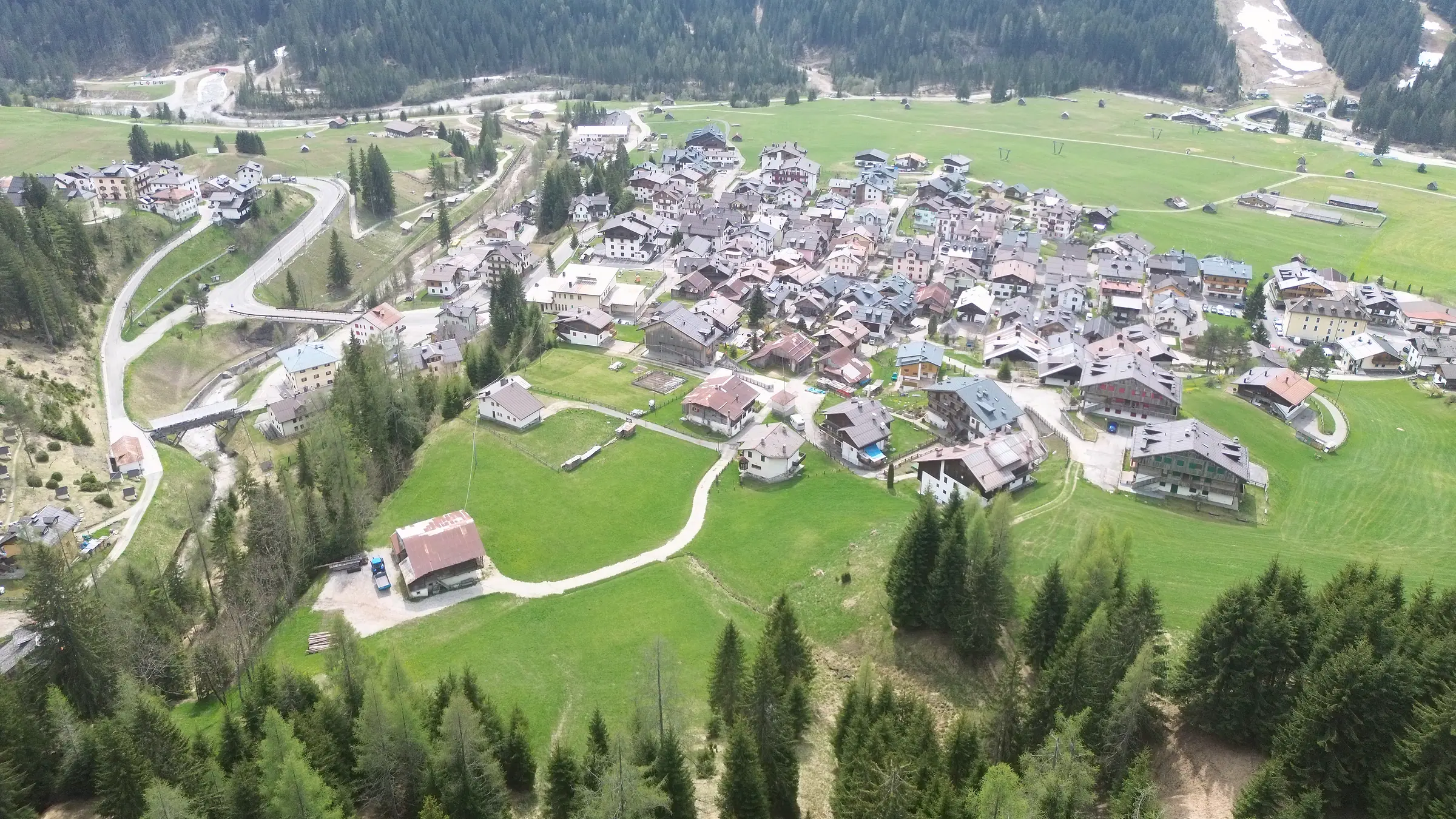
The census counts 2,762 dwellings in Sappada, and 76.5% have no residents in them: second homes, places let to tourists, houses left shut. Their owners usually open them at Christmas, on a few ski weekends and in summer; the remaining months the house stands alone, in a municipality of climate zone F, the coldest in the national classification.1114
Managing it from afar means three things. Keeping it in line with the Comune's rules, which in Sappada are mostly about snow. Paying the right taxes without losing the reductions due to non-residents. And having someone on the spot, because what matters happens when you are not there.
Snow: the roof, the pavement, the meadow
Sappada's building regulation has four rules that owners living far away need to know.
What Sappada's building regulation asks
- Snow guards. The roof must have them whenever the nature, pitch and materials of the covering may cause blocks of snow to fall onto public land (art. 59).1
- Pavements. Along properties facing public spaces the Comune lays out the pavements, but cleaning them and clearing the snow is up to the frontage owners (art. 63).1
- Fences and snow storage. The Comune also piles snow on private land, and the mayor may require fences and other obstacles to be removed for the winter; failing to do so incurs a penalty (art. 57).1
- Meadows and trees. The mayor may order private meadows to be mown or scrub cleared at the owner's expense, and have trees felled that obstruct snow clearing or snow storage (art. 58).1
Besides the regulation's requirement there is civil liability: everyone is liable for damage caused by things in their custody, unless they prove a fortuitous event. A slab of snow sliding off a roof onto the road or a neighbour's car can be damage of this kind; in a condominium, for the shared roof, the custodian is normally the condominium. For how much snow a roof must bear by law, our guide to risks has the loads calculated for Sappada's altitude.2
After heavy snowfall, then, someone has to look at the roof, the gutters and the snow guards, and clear the access: for your own visits, but also for a technician who needs to get in.
Frost and the systems
In a house closed for the winter the costliest risk is water: a pipe that freezes and bursts, discovered weeks later. The Comune's rules say nothing here; what counts are the owner's choices and the insurance policy, which should be read under frost and unoccupied homes.
The heating system, on the other hand, has precise obligations: the logbook, periodic inspections, registration in the regional register of systems. Our heating guide explains them, along with what a winter costs with the system turned down. For owners far away one thing more counts: the technician doing the inspections must be able to get in, so keys and a snow-free access are needed.
ILIA from afar: instalments, first building, reductions
ILIA, introduced by the Region in place of IMU and paid to the Comune, follows the national rules for payments and penalties: two instalments, the first by 16 June and the balance by 16 December. It is paid with the F24 form, code 5901 for the first building and 5902 for the others; if the F24 cannot be used from abroad, it is paid by bank transfer to the account indicated by the Comune, stating tax code, tax-payment code, year and instalment in the reference, and a copy of the transfer is sent to the Comune.3567
The rule that costs most to forget is the first-building one. Across the whole region each owner can pick just one dwelling, besides the main home, to count as their first: in Sappada it pays 0.7% instead of 1.06%. The choice is notified online, in the application provided by the Region, and the reduction is lost if this is not done by 30 June following the tax year. Once made, the notice remains good for later years too, until a new one is sent. Whoever does not make it pays the rate for additional dwellings.34
An example: the same flat, with and without the notice
- Hypothetical cadastral income: €500. ILIA taxable base, the income revalued by 5% and multiplied by 160: €84,000.34
- Designated as first building, at 0.7%: €588 a year.
- Without the notice, at 1.06%: €890 a year, that is €302 more.
- The notice is made once and stays valid: to designate a different house, a new one is sent.
Paying late or not at all brings the national penalty, currently 25% of the amount unpaid, cut by half when payment is at most ninety days late, and lower still with voluntary correction.8
Two reductions concern owners abroad specifically, and they go together. Regional law halves ILIA on one home only, provided it is not let or lent, belonging to someone who lives outside Italy and draws, in their State of residence, a pension accrued under an international agreement with Italy; on the same conditions national law cuts TARI by two thirds. Sappada's regulation, «unless national rules provide otherwise», writes the TARI reduction for Italian citizens registered with AIRE and already retired in the country where they live: which criterion the office applies today should be asked of the Comune.3913
The TARI of a home kept available
TARI is calculated in two parts: one on the square metres, the other on the number of people presumed to live in the home. For homes kept available by people who do not live there, Sappada's regulation counts the occupants by floor area, if the owner has not stated how many there are: two up to forty square metres, then one more for each band of twenty, up to six above one hundred square metres.9
A house that is closed but furnished, or has active utility contracts, pays all the same: the regulation says that not using the service does not exempt you from the tax. Only homes with no furniture and no active electricity, water or gas contracts are excluded, and this must be declared. Changes, for instance a different number of occupants or a house let out for over half the year, are reported to the Comune's TARI office within ninety days.9
When you lend the house
Lending the house to a brother or a friend for a week is not a let, and it does not require the national identification code. There is, however, a duty few people know about: if the guest is not a citizen of a European Union country, even when they are a relative, whoever gives them lodging has forty-eight hours to send a written notice to the local public-security office. The notice gives the details of host and guest, the guest's document, the address of the house and the basis on which it is provided. Failing to send it risks a fine from €500 to €3,500. Where there is no police station, the local public-security authority is the mayor: which office takes the notice in Sappada, the Comune will tell you.1015
If, on the other hand, you take payment for the house, the rules for letting apply: CIN, safety devices, guests reported to the Questura, tax on the rent. Our guides to short lets and to letting for the season explain them.12
Who keeps the keys
No rule requires anyone on the spot, but almost everything above assumes it: the roof to check after the snowfall, the pavement to clear, the boiler technician to let in, a water leak to stop.
What to leave with whoever keeps the keys
- A full set of keys and where the main water and gas taps, the fuse box and the boiler are.
- The system logbook and the name of the technician who does the inspections.
- Your insurer's number and that of a local plumber.
- What to check after heavy snowfall: roof, snow guards, gutters, access, pavement.
- If there is a condominium, the administrator's name.
- The dates when you or your guests arrive, and who they are, if they have to be reported.
Keep it, let it, sell it
There comes a moment when an owner managing from afar does the sums: ILIA and TARI running on, heating kept low, condominium charges, insurance, calls to whoever has the keys, and the weeks the house is actually used. There are three ways forward.
Letting it by the week needs, at every arrival, someone on the spot or a live video link, because guests have to be recognised and a key-box code alone is not enough: our guide to short lets explains how. Letting it for the whole season takes less work and a well-chosen contract: our guide to seasonal lets explains the two possible ones. Selling it closes the account: our guide to selling says where a defensible price comes from and which papers are needed before the listing. The costs of ownership, item by item, are in our guide to costs and taxes.
What we do
In Sappada our work is sales: we do not look after houses and we do not manage lettings. What we can do for those who own a house here and live far away is tell them what it is worth today, in writing and with every comparison in plain view, and come to see it by appointment: our office is in Trieste.
If managing the house from afar has become more burden than pleasure, let us start from that valuation. Deciding to keep it remains your choice, but made with the figures in hand.
What we do not know yet
Whatever we have not yet read in a reliable source is written here, rather than passed off as certain.
- Whether the Comune has issued snow ordinances for the 2026/27 winter going beyond the building regulation: we could not read the pages of the municipal website that carry the ordinances.
- What rules the water utility sets for meters in houses closed in winter.
- The 2026 TARI tariffs: on 31 October 2026 only those for 2025 had been published.
- Whether the Comune applies the TARI reduction by the regulation's criterion (AIRE-registered pensioners) or by that of national law (a pension under an international agreement).
Frequently asked questions
Do I have to clear the snow from the pavement in front of my house, even when I am not there?
Yes: along public spaces the building regulation puts the cleaning and snow clearing of pavements on the frontage owners. If you are not there, someone has to do it for you.
If snow slides off my roof and damages a car, who pays?
Whoever has the roof in custody: the owner of the house or, if the roof is shared, normally the condominium. The Civil Code makes them liable unless it was a fortuitous event; the building regulation, separately, requires snow guards where snow can fall onto public land.
I forgot to designate the house as my first building: what happens?
The Comune applies the rate for additional dwellings, 1.06% in Sappada. It can be put right only until 30 June of the following year, with the Region's online notice; from then on it stays valid.
How do I pay ILIA if I live abroad?
With the F24 form, if you can use it; otherwise pay by bank transfer to the details the Comune gives you, stating tax code, tax-payment code, year and instalment in the reference, and then sending the Comune a copy of the payment. There are two instalments, in June and December.
I am lending the house to an American friend for two weeks: do I have to report it?
Yes. For a guest from outside the EU the law obliges you to inform public security in writing, within forty-eight hours, even if the guest pays nothing and even if they are family.
Sources
Read on 31 October 2026. The numbers match the references in the text.
- Comune di Sappada/Plodn, municipal building regulation, variant no. 3, arts. 57, 58, 59 and 63, read on 31/10/2026comune.sappada.ud.it
- Civil Code, art. 2051: damage caused by things in custody, text in force, read on 31/10/2026normattiva.it
- Regione Friuli Venezia Giulia, Regional Law no. 17 of 14 November 2022 (ILIA), arts. 4, 5, 7, 9, 10, 13 bis and 19, text in force, read on 31/10/2026lexview-int.regione.fvg.it
- Comune di Sappada/Plodn, town council resolution no. 4 of 27/02/2026, ILIA rates 2026, read on 31/10/2026comune.sappada.ud.it
- Law no. 160 of 27 December 2019, art. 1, para. 762: IMU instalments, to which the regional ILIA law refers, text in force, read on 31/10/2026normattiva.it
- Agenzia delle Entrate, resolution no. 16/E of 12/03/2024: ILIA tax codes 5901 and 5902, copy by Regione Friuli Venezia Giulia, read on 31/10/2026autonomielocali.regione.fvg.it
- Ministry of Economy and Finance, press release no. 68 of 31/05/2012: payment of the tax by non-residents, read on 31/10/2026mef.gov.it
- Legislative Decree no. 471 of 18 December 1997, art. 13: late or missed payments, text in force, read on 31/10/2026normattiva.it
- Comune di Sappada/Plodn, TARI regulation (file published by the Comune as “Regolamento_TARI_2023”), arts. 2, 5, 7, 17, 23 and 32-bis, read on 31/10/2026comune.sappada.ud.it
- Legislative Decree no. 286 of 25 July 1998, arts. 1 and 7: notice by whoever lodges or hosts a foreign national, text in force, read on 31/10/2026normattiva.it
- ISTAT, permanent census of population and housing, municipality of Sappada, occupied and unoccupied dwellings, 2023esploradati.istat.it
- Decree-Law no. 145 of 18 October 2023, art. 13-ter: CIN and duties for tourist and short lets, text in force, read on 31/10/2026normattiva.it
- Law no. 178 of 30 December 2020, art. 1, para. 48: half IMU and TARI cut by two thirds for non-residents with a pension under an international agreement, text in force, read on 31/10/2026normattiva.it
- Presidential Decree no. 412 of 26 August 1993, art. 2: the six climate zones, text in force, read on 31/10/2026normattiva.it
- Law no. 121 of 1 April 1981, art. 15: the mayor as local public-security authority where there is no police station, text in force, read on 31/10/2026normattiva.it
Where the figures in this guide come from (15)
- Calcolo del sito sull'esempio della guida “gestire da lontano”: differenza annua fra l'aliquota delle abitazioni ulteriori e quella del primo fabbricato, arrotondata all'euro (302.40) · 31 October 2026
- ISTAT, Permanent Census of Population and Housing: occupied and unoccupied dwellings, municipality of Sappada, year 2023 · 6 October 2026
- Our calculation, based on: ISTAT, Permanent Census of Population and Housing: occupied and unoccupied dwellings, municipality of Sappada, year 2023. These are “dwellings not occupied by residents”: second homes, holiday lets and empty homes together · 6 October 2026
- ENEA, elenco “Gradi-giorni” dei comuni italiani: allegato A al D.P.R. 26 August 1993, n. 412, aggiornato coi decreti successivi (dati al 5 July 2002) · 7 October 2026
- Comune di Sappada/Plodn, deliberazione del Consiglio comunale n. 4 del 27/02/2026, aliquote ILIA 2026: 0.70% sul primo fabbricato ad uso abitativo diverso dall'abitazione principale (uno solo in regione per persona fisica, da comunicare alla Regione entro il 30 giugno dell'anno successivo; pertinenze escluse) · 6 October 2026
- Comune di Sappada/Plodn, deliberazione del Consiglio comunale n. 4 del 27/02/2026, aliquote ILIA 2026: 1.06% sulle abitazioni ulteriori e, senza la comunicazione del primo fabbricato, su ogni seconda casa · 6 October 2026
- D.Lgs. 18 December 1997, n. 471, art. 13, c. 1: sanzione per l'omesso o ritardato versamento, applicata all'ILIA per il rinvio alle regole dell'IMU (L.R. FVG 17/2022, art. 19) · 31 October 2026
- D.Lgs. 25 July 1998, n. 286, art. 7, c. 2-bis: sanzione minima per chi non comunica all'autorità di pubblica sicurezza di dare alloggio a uno straniero · 31 October 2026
- D.Lgs. 25 July 1998, n. 286, art. 7, c. 2-bis: sanzione massima per chi non comunica all'autorità di pubblica sicurezza di dare alloggio a uno straniero · 31 October 2026
- Status of our work in Sappada, reviewed on 2026-10-06 (to be reviewed again by 2026-12-31) · 6 October 2026
- Ipotesi del sito per l'esempio della guida “gestire da lontano”, non un dato osservato: rendita catastale di un bilocale · 31 October 2026
- Prezzo-valore: rendita catastale x 1.05 x 120 (110 con i benefici prima casa), L. 266/2005 art. 1 c. 497 e guida dell'Agenzia delle Entrate “L'acquisto della casa” (June 2024). Base ILIA: rendita x 1.05 x 160 per le abitazioni, L.R. FVG 17/2022. · 6 October 2026
- Calcolo del sito sull'esempio della guida “gestire da lontano”: base imponibile ILIA, rendita ipotetica di 500 euro × 1.05 × 160 (L.R. FVG 17/2022) · 31 October 2026
- Calcolo del sito sull'esempio della guida “gestire da lontano”: ILIA dell'anno allo 0.70% del primo fabbricato non principale (Sappada, 2026) · 31 October 2026
- Calcolo del sito sull'esempio della guida “gestire da lontano”: ILIA dell'anno all'1.06% delle abitazioni ulteriori (Sappada, 2026), arrotondata all'euro (890.40) · 31 October 2026
This guide explains general rules: it is not tax, legal or financial advice. Laws, rates and tariffs change; before you decide, have your own case checked by a notary and an accountant.
Read on
Other guides